

Course Information
Design for Reliability (DfR) Across the Product Lifecycle
Learners will be able to:
- Apply Design for Reliability as a business-driven engineering discipline across the product lifecycle.
- Use prediction, modeling, risk analysis, robust design, and testing methods to reduce reliability risk.
- Support production readiness decisions using reliability growth data, dashboards, and quantitative evidence.
About This Course
Design for Reliability (DfR) Across the Product Lifecycle provides a systems-level understanding of how reliability is designed, tested, managed, and improved across the product lifecycle.
In today’s competitive market, product reliability is not just an engineering metric. It is a critical business driver. This course bridges theoretical statistics and practical engineering application, helping learners understand how reliability practices support product performance, safety, cost control, customer satisfaction, and long-term business viability.
Learners begin with the strategic business case for DfR, then explore reliability prediction using industry-standard models, Physics-of-Failure concepts, and Monte Carlo simulation. The course also introduces risk analysis tools such as FMEA and Fault Tree Analysis, robust design methods such as Taguchi methods and Stress-Strength analysis, and reliability testing approaches including Accelerated Life Testing.
The course concludes with reliability growth and lifecycle decision-making, showing how Test, Analyze, and Fix cycles, reliability dashboards, and production readiness data support confident Go/No-Go decisions.
No formal prerequisites are required. Learners should have a basic understanding of product development, engineering, quality, or reliability concepts.
- English (EN-US)
- Chinese (simplified) (ZH)
- Czech (CS)
- French (FR)
- German (DE)
- Italian (IT)
- Japanese (no audio) (JA)
- Korean (no audio) (KO)
- Polish (PL)
- Portuguese (Brazilian) (PT-BR)
- Romanian RO)
- Russian (RU)
- Spanish (ES)
- Vietnamese (no audio) (VI)
Course Objectives
- Strategize for Business Impact: Contextualize Design for Reliability (DfR) not just as an engineering task, but as a critical business driver that supports organizational viability.
- Predict and Model Performance: Forecast failure rates and optimize system architectures using industry standards, Physics-of-Failure concepts, and Monte Carlo simulations.
- Understand Risk Analysis: Systematically identify and mitigate failure modes using core tools such as FMEA, Fault Tree Analysis, Risk Priority Number, and Action Priority concepts.
- Engineer Robust Designs: Minimize product sensitivity to environmental noise and variation using Taguchi methods, Stress-Strength analysis, and Design of Experiments.
- Accelerate Validation: Design effective testing programs, including Accelerated Life Testing, using Arrhenius and Inverse-Power Law models to predict field life in a fraction of the time.
- Drive Decision-Making: Manage the product lifecycle from Test, Analyze, and Fix growth cycles through Production Readiness Review using quantitative dashboards.
Course Outline
Lesson 1 | Role of Design for Reliability (DfR) in the Product Lifecycle
- Understand why Design for Reliability is crucial to business viability.
- Become familiar with core DfR concepts.
- Recognize reliability as a measurable engineering attribute that must be designed, tested, and managed across the product lifecycle.
Lesson 2 | Prediction, Modeling, and Prototyping
- Estimate failure rates using part stress methods, MIL-HDBK-217 concepts, and Physics-of-Failure methods.
- Evaluate system reliability across series, parallel, standby, and load-sharing configurations.
- Use Monte Carlo simulation to explore dynamic reliability problems.
- Understand how prototyping helps identify weaknesses before production.
Lesson 3 | Risk Analysis and Failure Analysis Tools
- Explain how risk is defined and assessed in reliability engineering.
- Apply structured tools such as Fault Tree Analysis, Success Tree Analysis, FMEA, FMECA, Common Mode Failure Analysis, risk matrices, hazard analysis, and system safety.
- Use Risk Priority Number and percent RPN reduction concepts to rank and track risk reduction actions.
Lesson 4 | Robust and Tolerant Design for Reliability
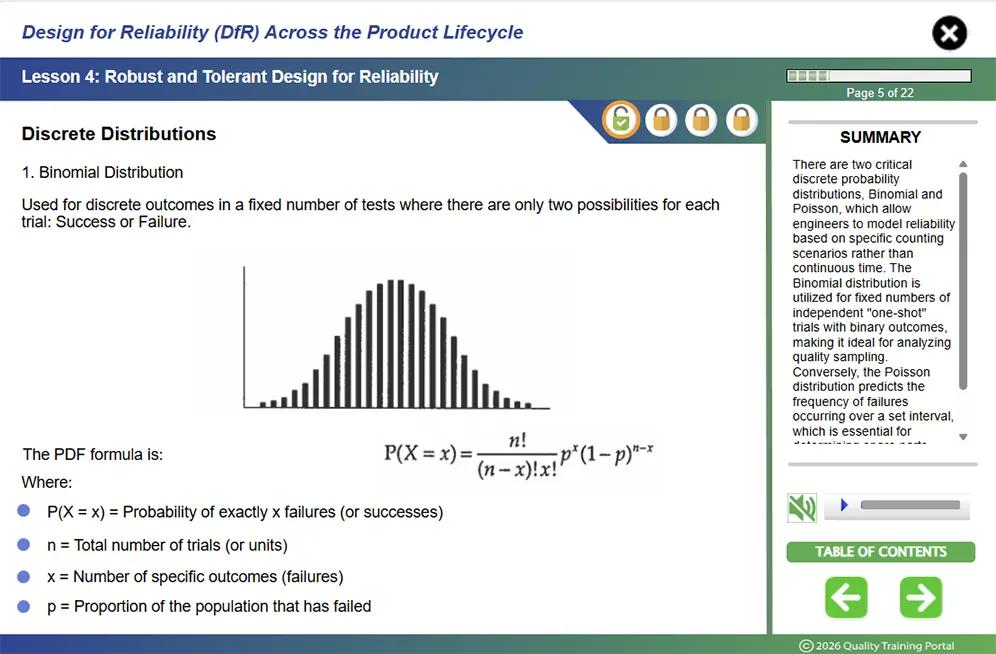
- Understand probability concepts and reliability-related distributions.
- Apply Taguchi methods to reduce sensitivity to variation and noise.
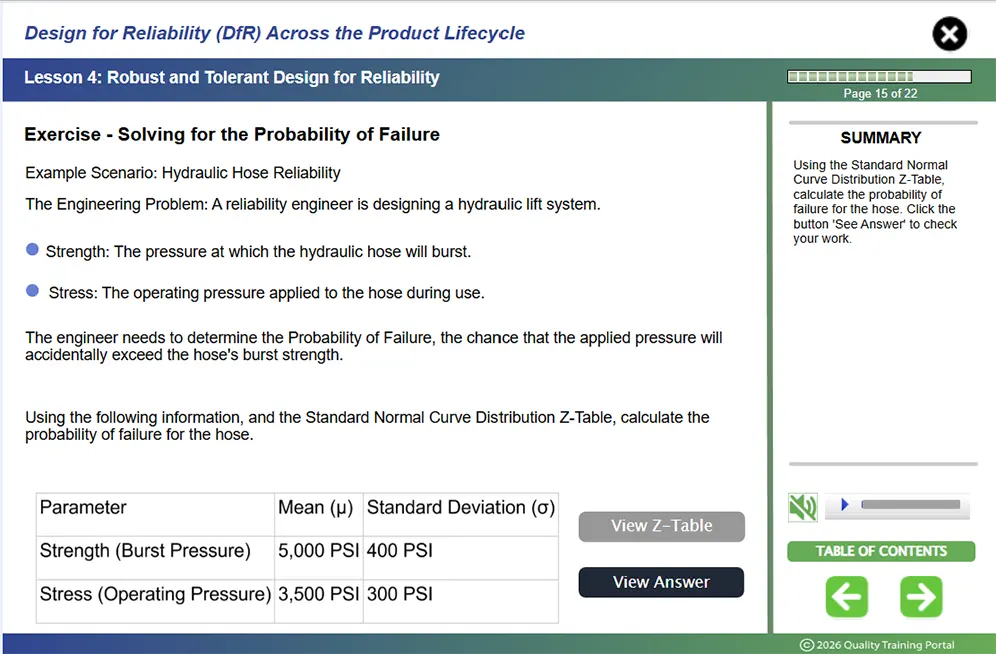
- Evaluate failure risks using Stress-Strength analysis and Design of Experiments.
- Use DfR strategies such as DfX, redundancy, and fault tolerance to improve reliability.
Lesson 5 | Reliability Testing and Accelerated Testing
- Understand the different types of reliability tests and how they are used.
- Explain why accelerated testing is essential in product development.
- Apply Accelerated Life Testing concepts using Arrhenius and Inverse-Power Law models.
- Differentiate discovery tests, measurement tests, acceptance tests, verification, and validation.
Lesson 6 | Reliability Growth and Continuous Improvement
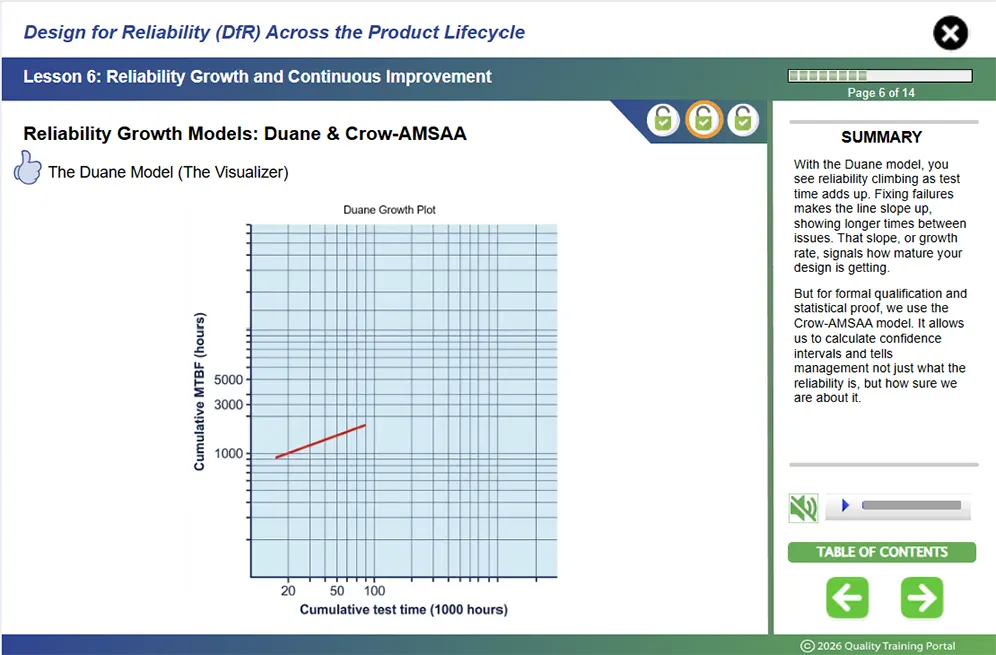
- Improve product performance through structured testing and corrective action using Test, Analyze, and Fix cycles.
- Prioritize risks using failure severity and FMEA criteria.
- Evaluate failures based on environmental stresses and real-world use profiles.
- Support Go/No-Go decisions using a Reliability Dashboard that summarizes MTBF goals, residual risks, and manufacturing yields.
Challenge
- A self-assessment that helps learners test their comprehension of the topics covered in this course.
Learner reviews will be added after course participants begin submitting feedback.
You may also be interested in…
- Design FMEAs Training – Step-by-step training on how to conduct traditional Design-FMEAs, use RPN results to prioritize risks, and create action plans to reduce risks that are unacceptably high.
- DOE: Screening Experiments Training – Learn how to use Design of Experiments techniques, including Plackett-Burman and Taguchi methods, to identify key factors, improve processes, and optimize product or process performance.
- Cost of Quality Training – Learn how to design and implement a Cost of Quality program, monitor COQ performance metrics, and focus improvement efforts on the metrics with the greatest impact.
- Root Cause Analysis Training – Comprehensive training that leads learners through a four-step process for identifying root causes, selecting effective solutions, and ensuring the gains made are held.