
Course Information
Introduction to COQ Training
Learners will be able to:
- Explain the purpose and value of measuring COQ.
- Describe the support structure needed for a COQ Program.
- Explain how approximation values are used to calculate COQ.
Introduction to COQ Training equips leaders, managers and supervisors with a working knowledge of Cost of Quality concepts and terminology, helping them interpret COQ reports, identify high-impact areas and track improvement over time.
This overview 2.0-hour course awards 0.2 CEUs/RUs, is designed for Managers, Executives/Sr Managers, and is available in multiple languages to support global teams.
About This Course
Why Does a Cost of Quality Program Matter?
Two often-repeated sayings capture the idea: “If you can’t measure it, you can’t improve it,” and “In God we trust, all others must bring data.”
The first reminds us that we can’t know whether we are successful unless we define what success looks like and measure our performance against it. The second adds an important dimension: we need data, not hunches or opinions, to understand how we are doing. Without a reliable way to collect and quantify performance, we are just guessing.
A Cost of Quality (COQ) program provides that data. A COQ program can:
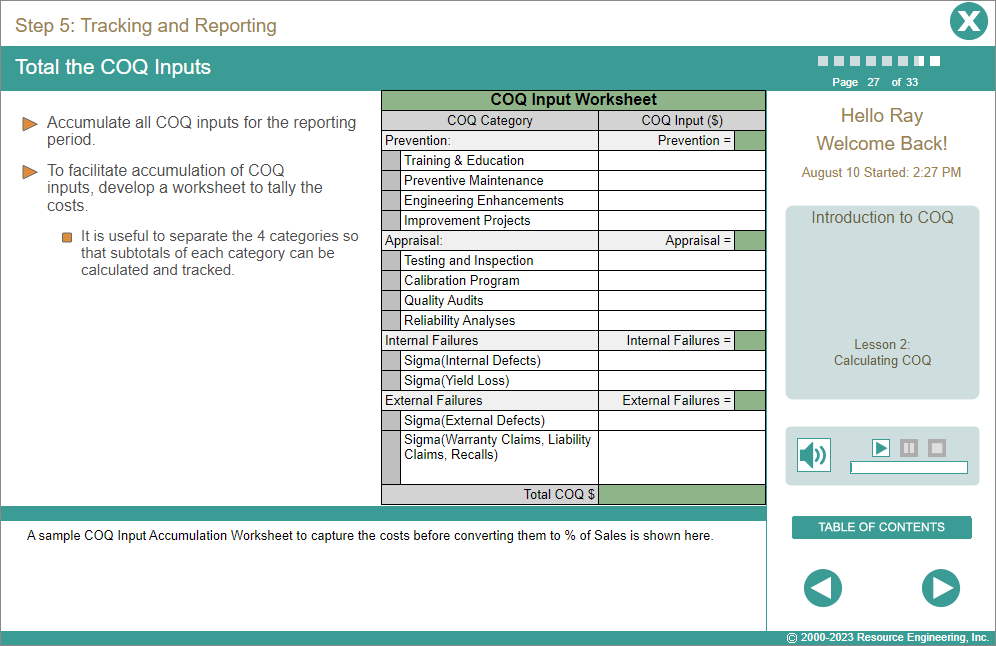
- Show approximately how much the organization spends, as a percentage of sales, on prevention, appraisal, and internal and external failure costs.
- Identify the processes, products or services that have the greatest impact on COQ.
- Track and monitor COQ over time to confirm whether improvement efforts are working.
Introduction to COQ Training
Introduction to COQ provides leaders, managers, supervisors and others who use, but are not involved in the day-to-day calculation and maintenance of, Cost of Quality reports with a working knowledge of the basic concepts and language of COQ. For comprehensive training, see Cost of Quality.
- None.
- English (EN-US)
- Chinese (simplified) (ZH)
- Czech (CS)
- French (FR)
- German (DE)
- Italian (IT)
- Japanese (no audio) (JA)
- Korean (no audio) (KO)
- Polish (PL)
- Portuguese (Brazilian) (PT-BR)
- Romanian RO)
- Russian (RU)
- Spanish (ES)
- Vietnamese (no audio) (VI)
Course Objectives
- Understand why an effort to measure and quantify COQ is important.
- Be aware of the structure needed to implement a successful COQ Program.
Course Outline
Lesson 1 | Why Measure COQ
- Understand the value of measuring and tracking Cost of Quality.
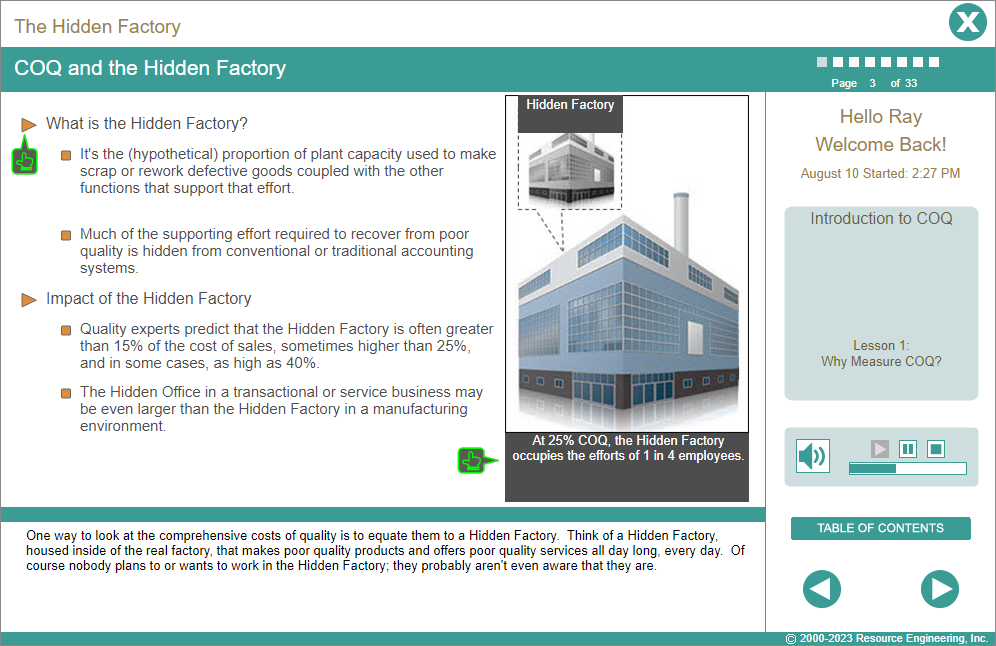
- Acknowledge and recognize “hidden” Costs of Quality.
- Understand the PAF Model for measuring COQ.
Lesson 2 | Calculating COQ
- Recognize the importance of gaining commitment for a COQ effort from Process Owners and the value of involving the Financial Department right at the start.
- Be aware of potential sources of data for COQ measures.
- Be familiar with how COQ data is grouped into appropriate PAF categories.
- Understand why “Approximation Values” are used to quantify COQ inputs. Recognize how to a COQ Reporting and Tracking System works.
Challenge
- An assessment of the learner’s progress in this course.

4.7 out of 5 stars
Comments from Learners About This Course
- This is a good overview of COQ.
- Detailed and consistent.
You may also be interested in…
- Cost of Quality Training – Provides a comprehensive understanding of how Cost of Quality can be used to measure and track quality and continuous improvement performance and progress.
- Root Cause Analysis with Corrective Action – Leads the learner through a four-step process to get to the root cause (source) of problems to eliminated problems for good.